
13 Tips for Relatives of Aphasia Patients: How to Support Rehabilitation

A stroke impacts the entire family. When aphasia affects a loved one, caregivers face unique challenges. Discover 13 practical tips to support recovery and strengthen communication together.
Understanding Aphasia: How Caregivers Can Help
Aphasia is a language disorder that usually occurs after a stroke or brain injury. Affected individuals experience difficulties with speaking, understanding, reading, or writing.
Intelligence remains intact! Your relative can think and feel just as before – only language is impaired. Never treat the person like a child.
Prevalence in USA:
Approximately 180,000 people develop aphasia each year after a stroke.
Around 2,000,000 people live permanently with aphasia.
The good news: With consistent therapy and your support, significant progress is possible. The brain can build new connections and regain abilities once thought lost, either partially or fully.
🏥 Important Note:
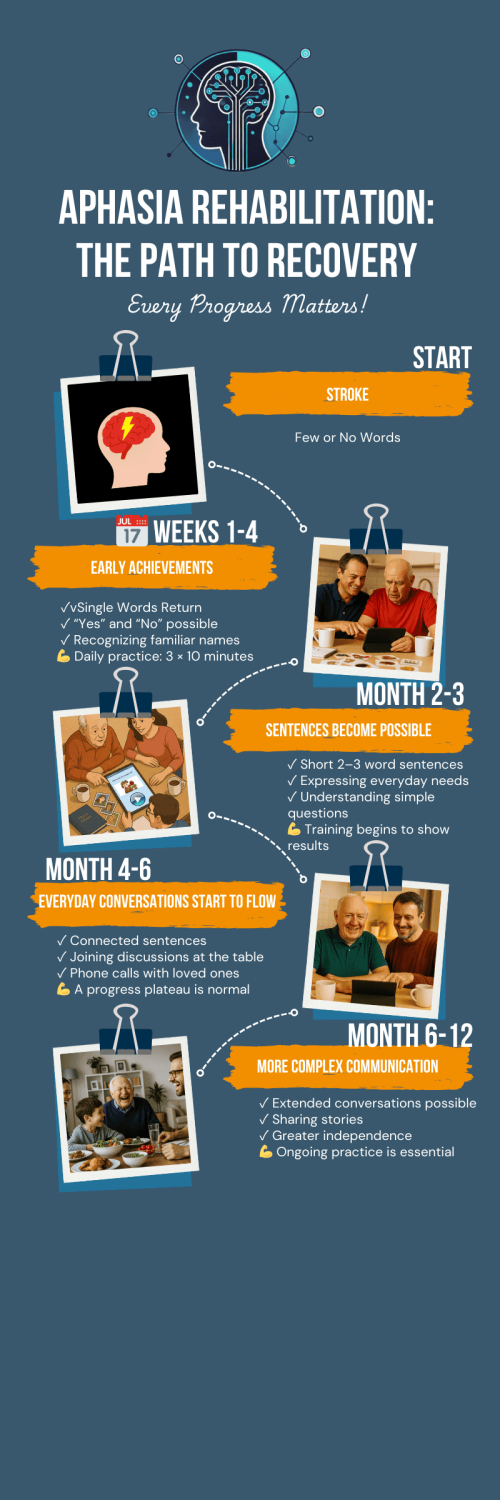
Rehabilitation after aphasia is a marathon, not a sprint. Patience and daily practice are the keys to success. The earlier and more consistently training takes place, the better the prognosis.
The first 6–12 months after a stroke are the most crucial for rehabilitation. Intensive therapy during this phase shows the best results.
🗣️ Speak Slowly and Clearly – But Not Childishly
Your relative is not cognitively impaired, but has a language disorder. Avoid:
- Baby talk or overly simplified sentences
- Speaking too loudly (as if the person were deaf)
- Showing impatience or visible frustration
Instead: Speak in a normal tone, but a little slower. Pause between sentences. Use clear, concrete language to support aphasia communication and rehabilitation.
 Allow Enough Time for Responses
Your relative’s brain is working harder than ever to find words. Silence is okay.
Practical Application:- Count silently to 10 before asking again
- Avoid finishing sentences for the person
- Show you are listening by nodding
- For longer pauses: “Take your time, I’ll wait”
 Takes away the patient’s chance to practice
- Leads to frustration and withdrawal
- Prevents progress in aphasia rehabilitation
- Sends the message: “You are too slow”
Instead:
Scenario:
Your relative is searching for the word “water”
 Wrong:
Patient: “I want… uh… the… w-w-”
Relative: [impatient] “Water? You want water?”
Patient: [nods frustrated, gives up speaking]
 Correct:
Patient: “I want… uh… the… w-w-”
Relative: [waits patiently 10 seconds]
Patient: [points to glass]
Relative: “Ah, water! Exactly, well done.”
“Say it again: Wa-ter”
Patient: “Wa… ter”
Relative: “Great! Here is your water.”
Helpful Strategies for Word-Finding Difficulties:
- Provide the first sound: “It starts with W…”
- Offer categories: “Is it a drink?”
- Ask for opposites: “The opposite of eating is…?”
- Allow gestures: pointing, drawing, gesturing
- Do not guess (unless asked)
 Common Pitfall: Many caregivers mean well and try to “help” by quickly suggesting words. The opposite is true: Wait! Words found independently are far more valuable for the healing process.
Tip 3
📝 Use Communication Aids
Communication is more than just speaking:
- Pictures and photos: Create a “communication book” with essential images
- Gestures: Encourage pointing and using gestures
- Writing: Sometimes writing works better than speaking
- Drawing: Simple sketches can help
- Communication board: Use a pointing board for basic communication
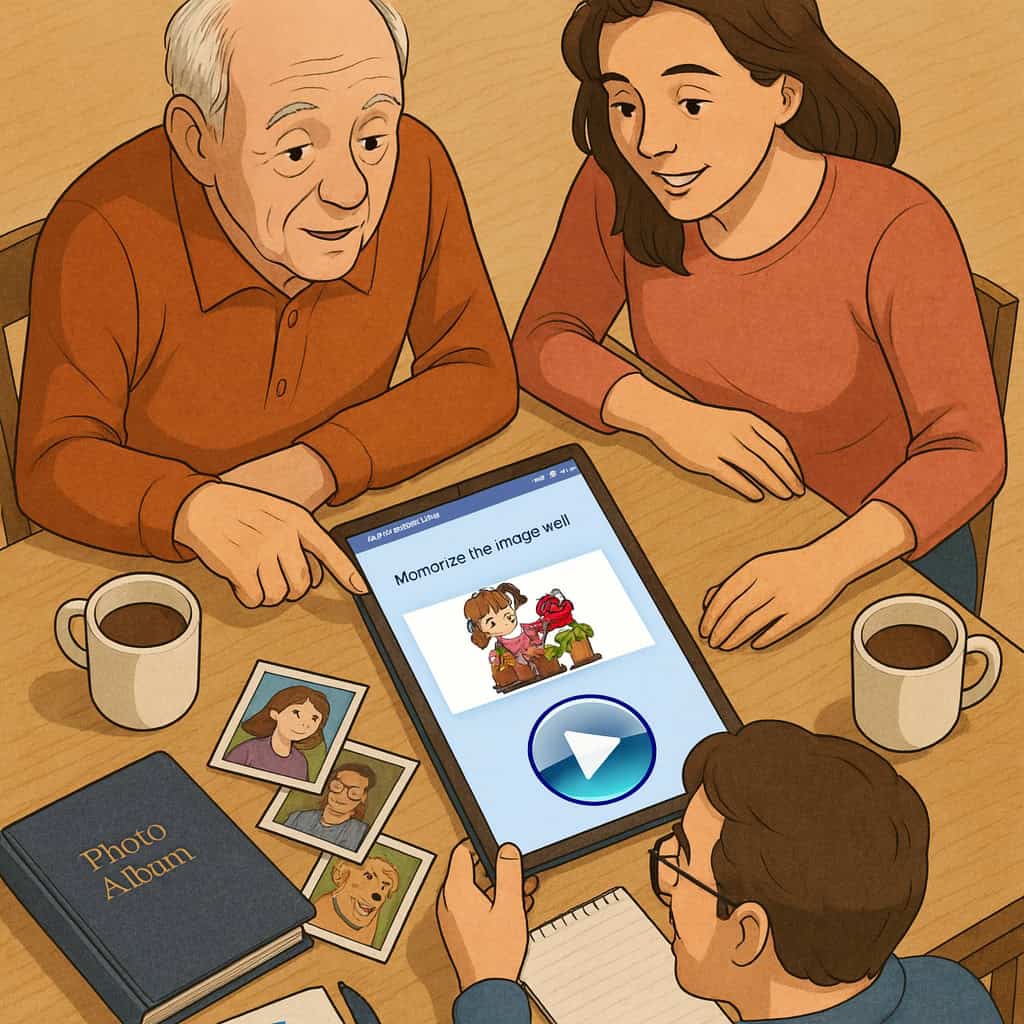
🚀 Daily Training Made Easy: The AphasiaAid App
The biggest challenge for many families: Long waiting times for speech therapy appointments and too much time between sessions.
The Solution: With the AphasiaAid App you can start right away: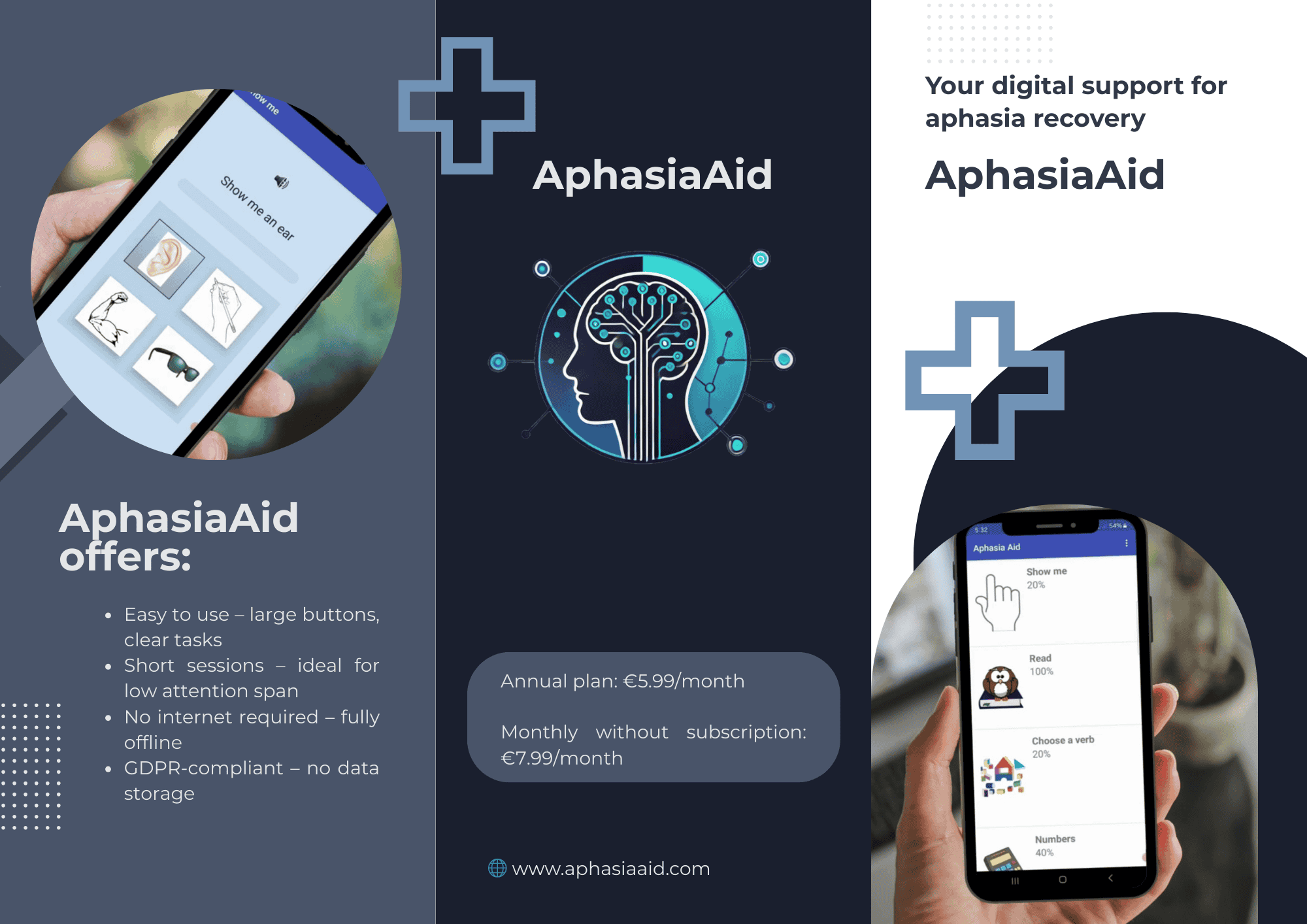
- 30+ exercise types
- Works completely offline – practice anywhere
- Large buttons & high contrast – designed especially for patients
- Progress tracking – see your achievements
- 5 difficulty levels – grows with abilities
📱 Download the App Now More Information
Tip 5
🎯 Start with Everyday Situations
The best exercises are those that are useful in real life:
- Shopping: “What else do we need?” – create a shopping list together
- Cooking: Read recipes aloud, name ingredients
- Watching TV: Talk about what you see
- Family photos: Recall names and events
Why this works: Emotional connections and practical relevance boost motivation and support learning in aphasia rehabilitation.
🎉 Celebrate Every Progress – No Matter How Small
Aphasia rehabilitation can be frustrating. Positive reinforcement is essential.
What you can celebrate:- A new word has been found
- A complete sentence has been spoken
- Exercises were completed without assistance
- Communication in daily life worked successfully
🤝 Seek Support – You Don’t Have to Do This Alone
Caring for a person with aphasia is emotionally and physically demanding.
⚠️ Important: If you are exhausted, you cannot help anyone. Self-care is not selfishness.
Why Self-Care Is Essential
- 🔥 Risk of Burnout: 60% of caregivers show symptoms of exhaustion
- 🔥 Your Own Health: Stress can lead to physical illness
- 🔥 Better Care: Only those who are stable themselves can provide strong support
Warning Signs of Overload
- ☐ Constant fatigue, even after sleep
- ☐ Irritability toward the patient
- ☐ Neglecting your own needs
- ☐ Social withdrawal (no friends anymore)
- ☐ Feelings of guilt when taking breaks
- ☐ Physical complaints (headache, back pain)
- ☐ Hopelessness or depression
Concrete Self-Care Strategies
- 🕐 Daily: 30 minutes for yourself (walk, reading, hobby)
- 🕐 Weekly: 2–3 hours outside the home (friends, sports)
- 🕐 Monthly: One full day/weekend of recovery
- Organize substitute care (family, nursing service, volunteers)
- Use day care services
- Entitlement to respite care (insurance covers up to 6 weeks/year)
- German Association for Speech Therapy (dbl)
- Stroke self-help groups
- Online forums: aphasie.org, schlaganfall-forum.de
- Personal psychotherapy (covered by insurance)
- Caregiver counseling at social services
- Pastoral care offers
💭 “I must be perfect” ← Wrong!Allow Yourself:
✅ “I am doing my best” ← Right!
- ✅ To feel impatience (it’s normal!)
- ✅ To need breaks
- ✅ To sometimes feel overwhelmed
- ✅ To say “No” occasionally
- ✅ To accept professional help
🎵 Use Music and Rhythm
Musical memory often remains intact, even when language is impaired.
Practical Ideas:- Sing old favorite songs together (lyrics often come automatically)
- Clap rhythmically to words and syllables
- Melodic intonation therapy (ask a speech therapist to demonstrate)
📱 Integrate Digital Therapy Tools into Daily Life
Modern technology makes speech therapy more accessible and effective:
Benefits of Digital Therapy:- Immediate availability: No waiting for appointments
- Unlimited repetitions: Practice as often as needed
- Objective progress tracking: Statistics and charts
- Variety: Many different exercise formats
- Independence: Patients can practice on their own (boosts self-esteem)
💡 Why AphasiaAid Was Developed Especially for Home Use:
The app was created out of personal experience: the developer originally built it for his own father, because months of waiting for speech therapy appointments were unbearable. The Result:- Exercises that truly help in everyday life
- Large, easy-to-recognize buttons (also suitable for motor impairments)
- No complicated operation
- Works without internet (in hospital or on the go)
- No data collection – GDPR-compliant and private
💪 Stay Patient and Realistic
Recovery after aphasia does not follow a straight line:
- Plateau phases are normal: Progress is not always upward
- Setbacks are part of the process: Stress, fatigue, or illness can temporarily worsen symptoms
- Complete recovery is not guaranteed: But quality of life can still improve significantly
- The greatest progress usually occurs within the first 6–12 months
- Improvements are still possible even years later
- Communication can succeed without perfect speech
👁️ Maintain Eye Contact and Listen Actively
Nonverbal communication becomes even more important after a stroke. Why eye contact matters:
- Shows attention and respect
- Helps with lip reading
- Conveys safety and reassurance
- Allows recognition of facial expressions and gestures
- Sit at eye level (avoid speaking while standing)
- Eliminate distractions (TV, radio, phone)
- Look directly at the person
- Nod affirmatively to show understanding
- Observe facial expressions and body language
- Ask: “Did I understand you correctly?”
🤲 Use Gestures and Facial Expressions Purposefully
Gestures and facial expressions are valuable tools to enhance understanding and enable simple responses.
| Situation | Gesture | Effect |
|---|---|---|
| “Drink?” | Pointing + drinking motion | Strengthens understanding |
| “Go outside?” | Pointing toward the door | Visualizes the question |
| “How are you?” | Thumbs up/down | Allows a simple answer |
🌍 Applications and Support for Families of Aphasia Patients
🇬🇧 UNITED KINGDOM (UK)
NHS (National Health Service) – Free Services:
1. Speech and Language Therapy (SLT)
- What: Free speech therapy via NHS
- How to apply:
- Referral by GP (family doctor) or directly after stroke in hospital
- No formal application required
- Waiting time: Can be 3–6 months
- Link: nhs.uk/conditions/speech-and-language-therapy
2. Personal Independence Payment (PIP)
- What: Financial support for people with disabilities (£28–£184/week)
- Who: Patient themselves (not caregivers)
- How to apply:
- Online: gov.uk/pip
- By phone: 0800 121 4433
- Complete form PIP2 + assessment
- Requirement: Difficulties with daily activities for at least 3 months
3. Carer’s Allowance
- What: £81.90/week for family caregivers
- Who: Caregivers providing at least 35 hours/week
- How to apply:
- Online: gov.uk/carers-allowance
- Form DS700 (postal application)
- Requirement:
- Patient must receive PIP or other benefits
- Caregiver earns under £151/week after deductions
4. Attendance Allowance
- What: £72.65–£108.55/week (for patients over 65)
- How to apply: gov.uk/attendance-allowance
- Form: AA1
5. Council Tax Reduction
- What: Reduction of local council tax
- How to apply: Through local council
- Requirement: Reduced income due to caregiving
6. Blue Badge (Parking Permit)
- What: Disabled parking permit
- How to apply: gov.uk/apply-blue-badge
- Cost: £10 (valid for 3 years)
7. NHS Continuing Healthcare
- What: Full coverage for complex care
- How to apply:
- Initiated by hospital/GP
- Checklist assessment required
- Link: nhs.uk – Continuing Healthcare
8. Direct Payments
- What: Money instead of services for self-organized care
- How to apply: Through Local Authority Social Services
- Use: Pay private speech therapists, therapy aids
Charity Support (UK):
- Stroke Association: Grants, free advice (stroke.org.uk)
- Speakability: Special focus on aphasia (speakability.org.uk)
- Carers UK: Advice for caregivers (carersuk.org)
🇺🇸 USA
Medicare (for 65+ or disabled):
1. Medicare Part B – Speech-Language Pathology
- What: Speech therapy (80% covered)
- Requirements:
- Doctor’s prescription
- “Medically necessary”
- Proof of improvement potential
- How to apply: Automatically via Medicare card at therapist
- Limit: $2,230/year (exceptions possible)
- Link: medicare.gov
2. Medicare Part A – Rehabilitation in Skilled Nursing Facility
- What: Intensive rehab after stroke (fully covered for 20 days)
- Requirement: Minimum 3-day hospital stay
- Days 21–100: Co-payment $204/day (2025)
3. Medicare Advantage (Part C)
- What: Private Medicare plans with extra benefits
- Often includes: More therapy sessions, transport, assistive devices
Medicaid (income-based):
4. Medicaid Long-Term Care Services
- What: Comprehensive care including speech therapy
- Who: People with low income/assets
- How to apply:
- Through State Medicaid Office
- Each state has its own rules
- Link: medicaid.gov
- Important: Consider “spend-down” rules
5. Home and Community-Based Services (HCBS) Waivers
- What: Care at home instead of nursing facility
- Includes: Speech therapy, personal care, respite care
- How to apply: Through State Medicaid
Social Security Administration (SSA):
6. Social Security Disability Insurance (SSDI)
- What: Monthly payments for disability
- Average: $1,537/month (2025)
- How to apply:
- Online: ssa.gov/disability
- By phone: 1-800-772-1213
- In person: Local SSA office
- Requirements:
- Disability lasting at least 12 months
- Sufficient “work credits”
- Duration: Decision may take 3–5 months
7. Supplemental Security Income (SSI)
- What: $943/month (2025) for disabled with low income
- Requirement: Very low income/assets
- Link: ssa.gov/ssi
Veterans Affairs (VA) – for Veterans:
8. VA Healthcare for Speech Therapy
- What: Free/reduced-cost speech therapy
- How: Through VA Medical Center
- Link: va.gov
9. Aid and Attendance Benefit
- What: Additional $2,266/month for veterans needing care
- Requirement: Veteran + need for caregiving
Private Insurance:
10. Private Health Insurance – Speech Therapy Coverage
- Varies greatly: Check your plan
- Typical: 20–60 sessions/year
- Pre-authorization: Often required
Other Programs:
11. Temporary Assistance for Needy Families (TANF)
- What: Financial support for families
- State-dependent
12. Supplemental Nutrition Assistance Program (SNAP)
- What: Food assistance (Food Stamps)
- How to apply: fns.usda.gov/snap
13. Low Income Home Energy Assistance Program (LIHEAP)
- What: Help with energy costs
- Link: acf.hhs.gov/ocs/liheap
Tax Benefits (USA):
14. Medical Expense Tax Deduction
- What: Deductible medical expenses (over 7.5% of AGI)
- Includes: Therapy, travel costs, assistive devices
15. Dependent Care Credit
- What: Tax credit for caregiving costs
- Up to: $3,000 for one person
Non-Profit Support (USA):
- National Aphasia Association: Resources, grants (aphasia.org)
- American Stroke Association: Programs, financial help (stroke.org)
- United Way: 211 – Local resource hotline (unitedway.org)
🇨🇦 CANADA
Provincial Health Insurance (varies by province):
1. Speech-Language Pathology Services
- Ontario (OHIP): Limited free SLP in clinics
- British Columbia (MSP): Partially covered
- Quebec (RAMQ): Free in public facilities
- How: Referral by family doctor
- Problem: Long waiting lists (3–12 months)
Canada Pension Plan (CPP):
2. CPP Disability Benefit
- What: Monthly payment (average $1,078/month, 2025)
- How to apply:
- Online: canada.ca/cpp-disability
- Complete form ISP1000
- Medical certificate required
- Requirements:
- Contributed to CPP (4 of last 6 years)
- Severe and permanent disability
- Duration: 4–6 months processing time
3. CPP Post-Retirement Disability Benefit
- What: For retirees who later become disabled
- Up to: $540.19/month in addition to pension
Provincial/Territorial Disability Programs:
4. Ontario Disability Support Program (ODSP)
- What: Up to $1,308/month (single) + additional benefits
- How to apply: mcss.gov.on.ca/odsp
- Includes: Medication, dental care, assistive devices
5. BC Persons with Disabilities (PWD)
- What: Up to $1,483/month
- Link: gov.bc.ca/personswithdisabilities
6. Quebec Solidarity Tax Credit
- What: Financial support
- Link: revenuquebec.ca
Employment Insurance (EI):
7. EI Compassionate Care Benefits
- What: 55% of income (up to $668/week) for 26 weeks
- Who: Caregivers who interrupt work for caregiving
- How to apply: canada.ca/ei-caregiving
- Requirement: 600 insured hours in last 52 weeks
8. EI Family Caregiver Benefit
- What: 15–35 weeks for critically ill adults
- Same conditions as above
Tax Credits (Canada):
9. Disability Tax Credit (DTC)
- What: $9,872 tax credit (2025)
- How to apply:
- Form T2201
- Completed by doctor
- Submit to CRA
- Link: canada.ca/disability-tax-credit
- Retroactive: Up to 10 years
10. Medical Expense Tax Credit
- What: 15–29% of costs over $2,759 (2025)
- Includes: Therapy, medication, home modifications
11. Caregiver Amount
- What: Up to $8,375 tax credit
- For: Family caregivers
12. Canada Caregiver Credit (CCC)
- What: Up to $7,999 for caregiving relatives
- Link: canada.ca/caregiver-credit
Home Care Programs (province-dependent):
13. Ontario Home Care
- What: Free home care including therapy
- How: healthcareathome.ca
- Through: LHIN/Ontario Health Teams
14. BC Home and Community Care
- What: Subsidized home care
- Link: gov.bc.ca/homecare
Equipment & Assistive Devices:
15. Assistive Devices Program (ADP) – Ontario
- What: 75% coverage for assistive devices
- Link: ontario.ca/adp
16. BC At-Home Program
- What: Up to $15,000 for home modifications
- Requirement: Low income
Veterans Affairs Canada:
17. VAC Disability Benefits
- What: Comprehensive support for veterans
- Link: veterans.gc.ca
Non-Profit (Canada):
- Aphasia Institute: Support, resources (aphasia.ca)
- Heart & Stroke Foundation: Programs (heartandstroke.ca)
🇦🇺 AUSTRALIA
Medicare (Universal Healthcare):
1. Medicare Speech Pathology Services
- What: Limited coverage (not comprehensive)
- Rebate: Partial reimbursement according to fee schedule
- How: Present Medicare card at therapist
- Link: servicesaustralia.gov.au/medicare
2. Chronic Disease Management (CDM) Plan
- What: Up to 5 allied health sessions/year (including SLP)
- How:
- GP creates Team Care Arrangement (TCA)
- Referral to speech pathologist
- Medicare pays ~$60 per session
- Link: health.gov.au/cdm
National Disability Insurance Scheme (NDIS):
3. NDIS Speech Therapy Funding
- What: Comprehensive funding for therapy + assistive devices
- Who: People under 65 with permanent disability
- How to apply:
- Online: ndis.gov.au
- Phone: 1800 800 110
- Form: “Access Request Form”
- Includes: Speech therapy, assistive technology (apps, tablets, communication devices), transport, respite care
- Plan budget: $10,000–$50,000+/year (individual)
- Important: Evidence from at least 2 health professionals required
4. NDIS Support Coordination
- What: Help navigating the NDIS system
- Included: In NDIS plan
Centrelink (Services Australia):
5. Disability Support Pension (DSP)
- What: $1,116.30/fortnight (single, 2025)
- How to apply:
- Online: servicesaustralia.gov.au/dsp
- Phone: 132 717
- In person: Centrelink office
- Requirements:
- Permanently unable to work (min. 15 hrs/week)
- Under 67 years
- 10 years residency in Australia
- Additional: Rent Assistance, Pharmaceutical Allowance
6. Carer Payment
- What: $1,116.30/fortnight for full-time caregivers
- Requirement: At least 6 months of caregiving
- Link: servicesaustralia.gov.au/carer-payment
7. Carer Allowance
- What: $150.80/fortnight (can be combined with Carer Payment)
- For: Daily care and support
- No income limit
8. JobSeeker Payment
- What: $762.70/fortnight (with partial capacity to work)
- For: Patients able to work in limited capacity
Department of Veterans’ Affairs (DVA):
9. DVA Allied Health Services
- What: Free speech therapy for veterans
- Link: dva.gov.au
10. DVA Disability Pension
- What: Payments for war-related disabilities
- Varies: Depending on degree of impairment
Commonwealth Home Support Programme (CHSP):
11. CHSP Services
- What: Home support for 65+ (or 50+ for Aboriginal/Torres Strait Islander)
- Includes: Household support, transport, social support, allied health (limited SLP)
- How: myagedcare.gov.au
- Phone: 1800 200 422
Home Care Packages:
12. Home Care Package (Level 1–4)
- What: $9,000–$58,000/year for home care (65+)
- Level 4: For high care needs
- How to apply: Through My Aged Care (ACAT assessment required)
- Can include: Speech therapy, personal care, equipment
State/Territory Programs (vary):
13. NSW Enable NSW
- What: Support for people with disabilities (not eligible for NDIS)
- Link: enable.health.nsw.gov.au
14. Victoria State Disability Service
15. Queensland Disability Services
- Link: qld.gov.au/disability
Tax & Financial:
16. Medical Expenses Tax Offset (abolished 2019)
- Note: Some costs can still be claimed as deductions
- See: ato.gov.au
17. Carer Adjustment Payment
- What: One-time $10,000 (paid in 2 installments)
- For: Parents/caregivers of severely disabled individuals
Equipment & Aids:
18. Continence Aids Payment Scheme (CAPS)
- What: $440–$572/year for continence aids
- Link: health.gov.au/caps
19. State Equipment Programs
- Example NSW: Lifetime Care Support Scheme
- What: Lifetime coverage for stroke patients from accidents
Non-Profit (Australia):
- StrokeLine: 1800 787 653 – Free advice
- Aphasia Australia: Resources (aphasia.org.au)
- EnableMe: Peer-support platform (enableme.org.au)
💡 Important Tips for All Countries
1. Documentation is Everything
- Collect ALL medical reports
- Keep a caregiving diary
- Photograph daily life (shows limitations)
- Save speech therapy progress reports
2. Respect Deadlines
- Many benefits have application deadlines (e.g., within 3 months after stroke)
- Denials can be appealed – do NOT give up!
3. Combine Multiple Benefits
- You can often receive several benefits at the same time
- Example UK: PIP + Carer’s Allowance + Council Tax Reduction
- Example USA: SSDI + Medicare + SNAP
4. Seek Professional Help
- UK: Citizens Advice Bureau (free)
- USA: Disability Advocates, Elder Law Attorneys
- Canada: Community Legal Clinics
- Australia: Financial Counsellors, NDIS Support Coordinators
5. Do Not Give Up Too Early
- Denial rates are high (especially USA SSDI: 60–70%)
- Appeal! File objections
- Success rates are much higher with lawyer/advocate support
📞 Important Hotlines
United Kingdom (UK)
- Stroke Association: 0303 3033 100
- Carers UK: 0808 808 7777
United States (USA)
- National Aphasia Association: 212-267-2814
- Eldercare Locator: 1-800-677-1116
Canada
- Service Canada: 1-800-622-6232
- 211 (Local resources)
Australia
- StrokeLine: 1800 787 653
- NDIS: 1800 800 110
- My Aged Care: 1800 200 422
Avoid Common Mistakes
What You Should NOT Do:
- ❌ Speak for the patient: Even if it seems faster – allow time for their own answers
- ❌ Talk about the patient: As if they were not present (very hurtful!)
- ❌ Give up after setbacks: Plateaus are normal in aphasia recovery
- ❌ Rely only on professional therapy: Home practice is just as important
- ❌ Neglect yourself: Burnout helps no one
The Role of Family in Aphasia Therapy
Studies clearly show: Patients with dedicated family support recover significantly better than those who rely only on professional therapy.

-
More practice time through daily training
-
An emotionally safe environment encourages willingness to learn
-
Practical application in everyday life reinforces what has been learned
-
Motivation through loving support
✅ Key Takeaways:
- Regular practice is more important than long sessions
- Patience and positive reinforcement support the healing process
- Digital tools like AphasiaAid enable immediate, flexible training
- You don’t have to wait: Start rehabilitation today
- Small steps add up to big successes
💡 Every day you practice is a step toward recovery. With the right tools, patience, and love, your relative can rejoin life – perhaps differently than before, but fulfilled and communicative.
🏥 Medical Disclaimer: This article is for informational purposes only and does not replace professional medical advice. Always consult a doctor or speech therapist for health-related questions. The AphasiaAid App is a supportive tool for rehabilitation and does not replace speech therapy.
 Imprint
 Privacy Policy & Cookies
 Terms & Conditions